
Can an Alarm System Still Send a Signal During a Power Outage?
A standby battery keeps the panel running when the building loses power, but the panel is not the part that carries the signal out. Here is what keeps reporting during an outage, and what stops without telling you.
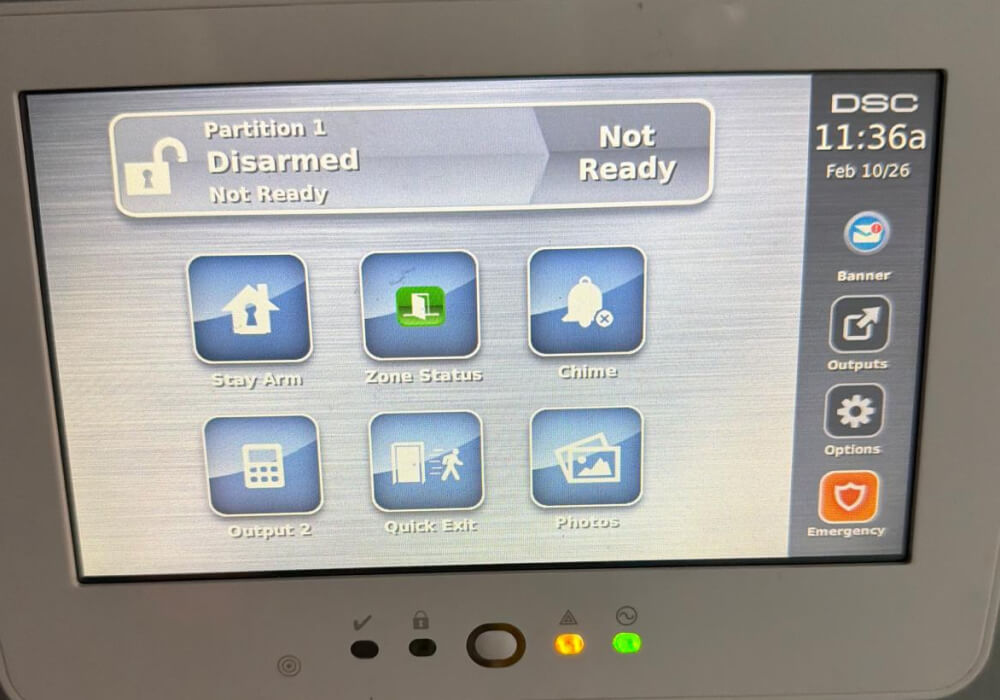
After an overnight power outage, the alarm system may look completely normal. The keypad is lit, the system is armed, and there are no alarms showing. But that does not tell you whether it could have sent a signal to the monitoring center while the power was off.
For most commercial systems the answer is yes, but it rests on something other than the panel. A standby battery keeps the panel running when the building goes dark. It does not keep your network equipment running. Whether a signal actually leaves the building comes down to which path it was using, and whether a second one was there.
The panel and the signal path are two different things
Almost every conversation about outages centers on the panel, because it is the part people can point at. It has a battery, so the system feels covered. That is half of it.
An alarm is only useful outside the building if the report gets out, and that report travels on a path with its own power supply and its own dependencies. Nobody has a light on the wall for that half.
The split is worth being exact about, because it is the thing that decides whether an event during the outage gets reported to anyone at all, or simply happens inside a building where the system looked fine the whole time:
- The standby battery carries the panel side, including the control panel and equipment powered through it. Some connected devices may have their own batteries or separate power supplies.
- It does not normally carry the network side. Unless the modem, router and switch have backup power of their own, the IP path goes down shortly after the building loses power.
What actually happens in the first minute
The order matters, because it explains how a system can look completely untouched and still have gone quiet. On a typical commercial install with a dual path communicator, the first minute of an outage runs in a predictable sequence:
- At the moment power drops: the panel switches to its standby battery without interruption, and the keypad, detectors and sounder carry on as normal.
- Within a few seconds: network equipment without backup power shuts down and the IP path is lost. A properly backed-up cellular communicator can continue reporting through the outage.
- After a programmed delay: the panel reports an AC loss trouble condition to the monitoring center, that delay being a setting so a brief flicker does not generate a report every time.
That AC loss report is the most useful thing here, because it is a live test of your signal path that happens before any break-in does. If it arrives, a path is working, and what happens next at the monitoring center is its own separate matter. If nothing arrives, nobody learns that unless someone is watching for it.
What the standby battery covers, and what decides how long it lasts
Runtime is not a number anyone can quote without looking at the panel. It depends on the battery capacity, its condition and the total load on the system. A large panel with several keypads, powered devices and expansion modules will use its reserve faster than a smaller system.
Age is the part that gets missed. Sealed lead acid batteries lose the ability to hold a charge whether or not the system has ever run on them, and common industry guidance puts replacement at around five years. A battery at year seven can charge normally, show no fault, and still collapse under the load of a real outage.
The panel may give you some warning. A low-battery condition can appear at the keypad and, depending on the account setup, may also be reported to the monitoring center. However, an aging battery can still pass a routine check and fail when a long outage puts it under load.
The paths out of the building, and why losing one can be silent
Three routes have historically carried a commercial alarm signal out of a building, a copper phone line, the building’s internet connection, and a cellular radio.
Copper phone service is being retired as carriers move customers to fiber and wireless networks. A commercial alarm that still depends on a traditional phone line should be checked now, before the carrier discontinues that service or changes the way the line is delivered.
Cellular has become a common communication path for commercial alarm systems. Depending on the equipment and carrier, the communicator may use LTE-M or another supported LTE network designed for long-term machine-to-machine communication. Older 3G communicators stopped working in 2022.
Supervision is what turns two paths into something better than one. Each path sends periodic check-in signals, so when one stops reporting, the surviving path is what lets that silence be noticed and passed along. A single path system has nothing left to carry that news, which is the same failure shape that leaves a camera streaming while nothing is being recorded.
What happens when the power comes back
Restoration gets treated as the end of the problem, and it usually is not.
A battery that has carried the panel for several hours comes back deeply discharged, and recharging it is slow. For a stretch after the lights return, the system is running on mains with very little reserve behind it, so a second outage in the same week is not the same event as the first. If another outage follows before the battery has fully recharged, the system may have much less reserve available the second time.
The other thing to check is whether everything came back. A panel normally sends restore signals when AC returns, but a communicator that lost its connection does not always re-register cleanly, and a router that came up with a changed configuration can leave the IP path dead. The panel can be perfectly content. The path may not be there.
What to settle before the next outage
You can confirm some of this with your monitoring provider, while battery testing and communication problems may need to be checked at the panel. Either way, it is better to find the answer during normal conditions than during an outage. If you are unsure how your own commercial alarm system was configured, four questions will surface it:
- When did each path last check in successfully: this proves the path end to end, which no amount of looking at the keypad can do.
- How old is the standby battery: if its installation date is unknown, have its condition tested and record the date of the next replacement.
- Is there a second path, and has it been tested recently: a system may still appear to be operating normally even when one of its communication paths is no longer checking in.
- Is the network equipment on a UPS: the panel has a battery, and giving the modem and router the same protection keeps the IP path alive through a short outage.
Check your Dallas alarm signal path before the next outage
If you are not certain your alarm can reach anyone when the building loses power, TXP Security can review the signal path on your existing system across Dallas, Plano, Irving, Richardson and the surrounding areas. We confirm which paths are live, test each one against the monitoring center, check the standby battery under load, and tell you plainly where the gap sits. Call 866-322-9555 or request a quote.
Frequently Asked Questions
How long does the panel battery keep the system running
It depends on the battery’s capacity, its age, and how much the panel is powering. More keypads, detectors and expansion boards shorten the run, and a battery past about five years may hold well under its rating.
Will we be told if the alarm loses its path to the monitoring center
On a supervised dual path system the surviving path can report that the other stopped checking in, and the panel posts a trouble condition locally. A single path system may have nothing left to report the failure with.
Does the alarm still sound inside if the signal cannot get out
Generally yes, as long as the sounder and any separate power supply supporting it still have backup power. The local alarm may continue even when no signal can leave the building.
What should we test after a network or internet change at the building
Ask for a signal test on every path rather than the one you assume is primary, confirm the monitoring center received each one, and check the panel is clear of trouble conditions afterward.